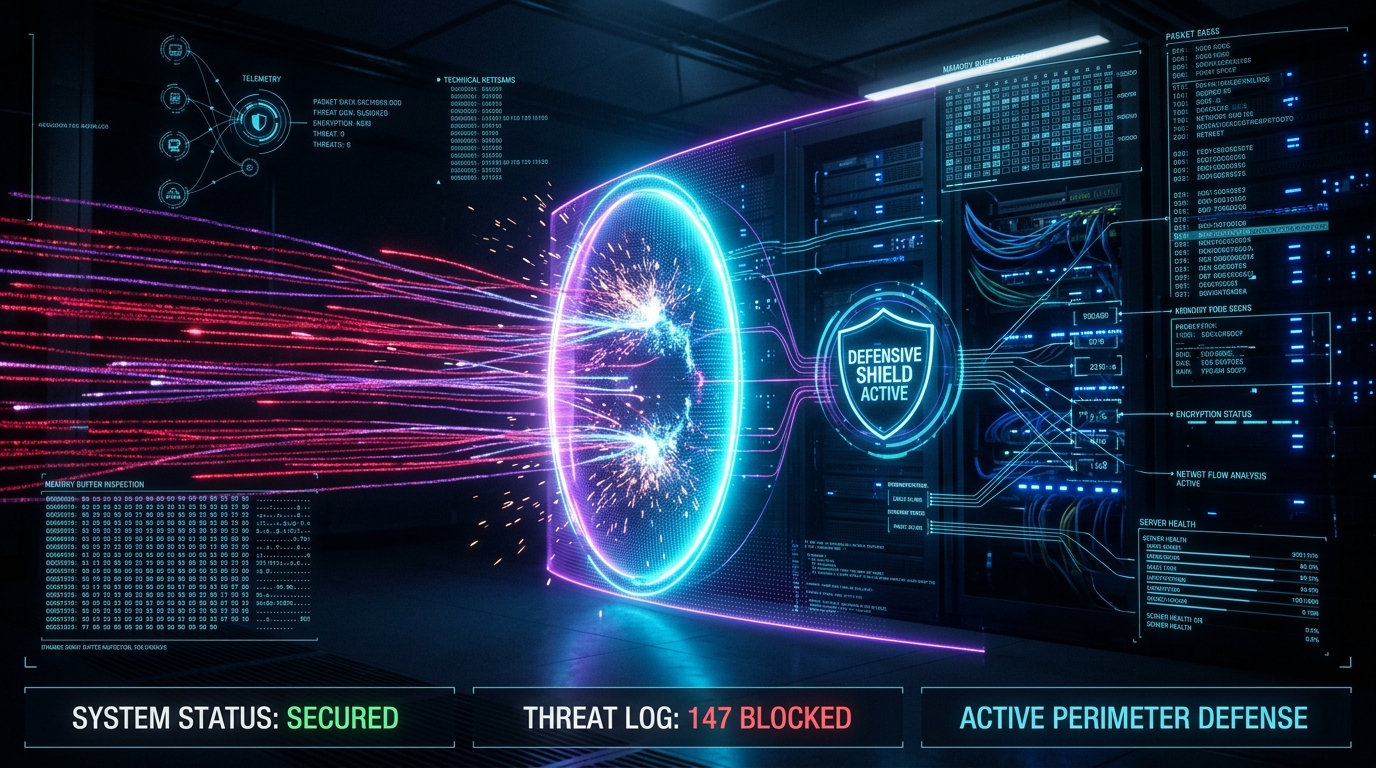
On Wednesday, October 21, 2026, the global web hosting ecosystem encountered an existential threat. Public exploit code dropped for two catastrophic zero-day vulnerabilities rooted deep inside the PHP C engine: CVE-2026-109618 and CVE-2026-109619, collectively dubbed "PHP2Shell".
Unlike standard CMS vulnerabilities that live in PHP userland code, these flaws triggered within the low-level memory allocator and session handler of the interpreter itself. They execute before WordPress, Magento, Laravel, or custom web application firewalls ever parse a request line. Within hours, weaponized automated scanners saturated IP blocks worldwide.
Across the UK, Europe, and North America, governments, hospital systems, and global tech platforms fell into emergency lockdowns or suffered crippling outages. Yet across Sysafe’s managed infrastructure fleets—spanning high-density multi-tenant environments and mission-critical standalone clusters—not a single production host was compromised, and not a single client suffered a service interruption.
Sysafe Proactive Defenses Mobilized
The Anatomy of the Flaws: Why Application-Layer Defenses Stood No Chance
Understanding why PHP2Shell caused unprecedented disruption requires looking past application code into the low-level memory mechanics of the PHP runtime:
-
CVE-2026-109618 (CVSS 9.2 • Heap-Use-After-Free):
This flaw lies within PHP's core
multipart/form-dataparser. When a client submits an HTTP POST containing intentionally malformed multipart boundary headers, boundary termination sequences, and fragmented mime-parts, PHP’s memory allocator hits an unhandled error condition. The engine triggers a bailout routine that unwinds the execution stack usinglongjmp().
Because the stack unwinding aborts standard garbage collection sweeps, dangling pointers remain in Zend hash tables and string pools. Attackers weaponized this condition by spraying heap chunks in successive requests, manipulating freed memory pointers to achieve unauthenticated Remote Code Execution (RCE) with the privileges of the web worker pool. -
CVE-2026-109619 (CVSS 9.2 • Stale Request Global Bleed):
Stemming from PHP's built-in
session.upload_progressfeature, this flaw occurs when concurrent HTTP requests send forged progress tracking parameters across persistent FastCGI/PHP-FPM worker pools. Internal request-bound global variables failed to zero out cleanly between request boundaries. As worker threads recycled, raw memory buffers—including session keys, cryptographic salts, and administrator tokens from previous requests—leaked directly into subsequent unauthenticated visitor sessions.
Because both vulnerabilities execute inside the C binary before PHP userland starts, conventional security plugins (Wordfence, iThemes, Sucuri) and local .htaccess directives were completely blind to the attack. The interpreter crashed or executed arbitrary payloads before application code received a single byte.
The Global Fallout: Outages, Panic, and Upstream Repository Collapse
As proof-of-concept exploits circulated publicly on GitHub and Underground forums, panic set in across the hosting and enterprise sectors. High-profile services were taken offline in emergency self-defense:
- UK Public Sector: Gov.uk reported severe disruption across 32 digital service endpoints, while the DVSA (Driver and Vehicle Standards Agency) was forced to temporarily suspend MOT vehicle testing across testing stations in England, Scotland, and Wales due to booking portal isolations.
- European Public Administration: The Netherlands government placed citizen authentication platforms DigiD and MijnOverheid into emergency lockdown; simultaneously, the Port of Rotterdam paused external logistics interfaces to evaluate core web stacks. In Belgium, the nationwide Smartschool education network (serving over 500,000 pupils) and the Flemish Parliament portal experienced emergency outages.
- Healthcare Portals: Patient appointment portals across multiple UK NHS regional trust systems and the Antwerp hospital group temporarily restricted external web forms to prevent data contamination.
- Tech Giants & Social Platforms: Creative community platform DeviantArt placed millions of users into a restricted read-only mode to prevent multipart exploits; Wikimedia quarantined internal Phabricator project instances; and Reddit experienced widespread API and upload throttling.
The Upstream Packaging Breakdown
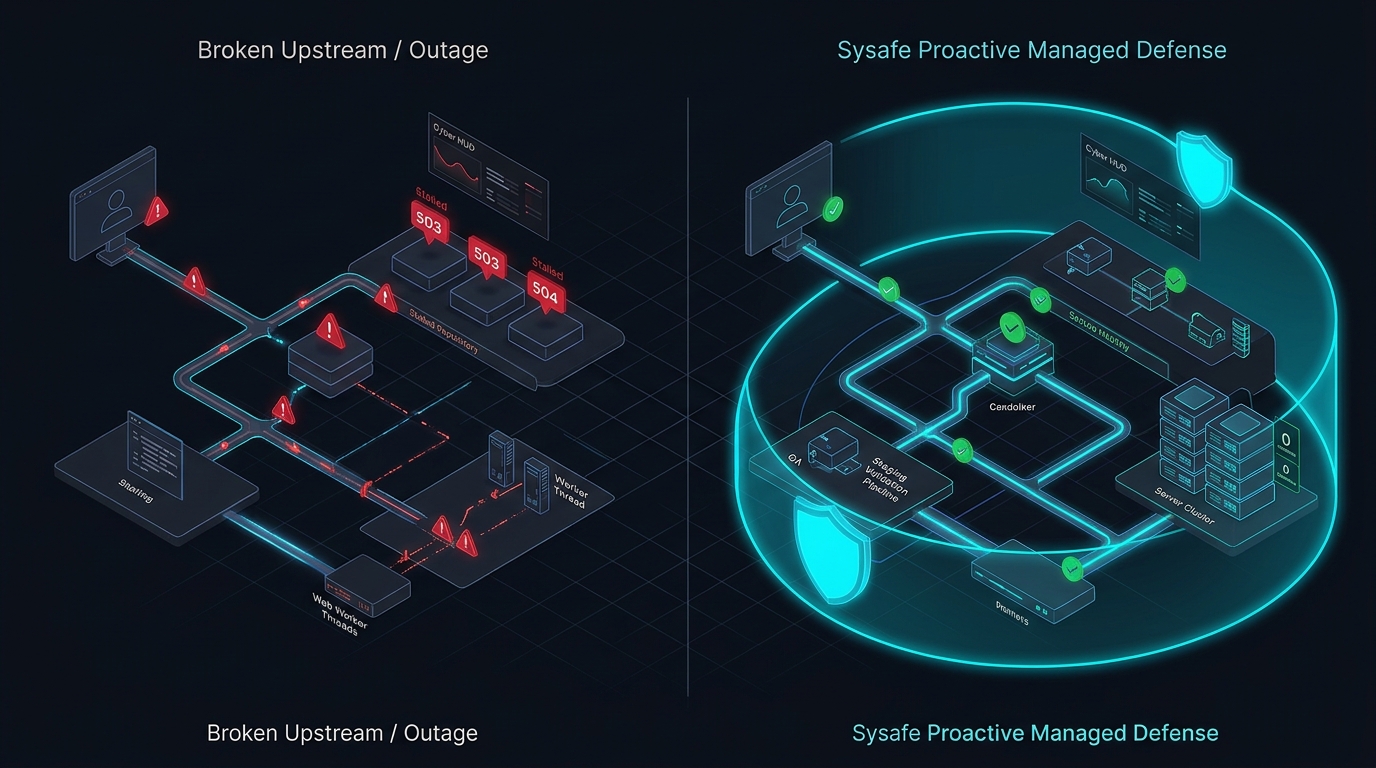
When the PHP core team released emergency source diffs, a secondary catastrophe struck: the packaging supply chain broke under crushing load. As millions of panicked system administrators ran apt-get upgrade and yum update simultaneously, primary upstream package repositories collapsed. Ondřej Surý’s widely used Debian/Ubuntu PPA (deb.sury.org) and Ubuntu Launchpad mirrors threw cascading HTTP 503 Service Unavailable and 504 Gateway Timeouts. Global sysadmins who relied solely on automated upstream repos found themselves locked out and completely defenseless.
The Sysafe Response: Measured Engineering, Zero Outages
While the broader internet scrambled, Sysafe's Security Operations team executed our pre-defined zero-day incident response protocol in three deliberate phases:
1. Immediate Ingress Shielding (< 15 Minutes)
Rather than betting production stability on crashing package repositories, Sysafe moved instantly to insulate the runtime at the HTTP boundary. Within minutes of disclosure, our Managed Defence engine rolled out virtual patching rules across reverse proxies and edge inspection nodes:
- Global Upload Progress Deactivation:
session.upload_progress.enabledwas stripped and neutralized across global master templates, permanently severing the memory bleed vector in CVE-2026-109619. - Multipart Boundary Normalization: Edge proxies immediately began enforcing strict RFC 7578 boundary termination syntax and rejecting malformed multipart envelopes before requests could ever touch PHP-FPM or FastCGI sockets.
2. Local QA Staging & Regression Verification
When official upstream source updates for active branches (PHP 8.4.27) and vendor advisories dropped, Sysafe refused to rush unverified binaries directly onto client servers. Upgrades were pulled into an isolated local QA testing node running automated integration suites across active client CMS stacks (WordPress, WooCommerce, custom frameworks).
We tested complex multi-step e-commerce checkout funnels, legitimate file upload flows, webhook endpoints, and tokenized APIs. This rigorous testing verified that the upstream patch introduced zero breaking changes or checkout bugs before deployment commenced.
3. The Midnight ELS Rollout: 400+ Packages, Zero Downtime
The greatest challenge in any enterprise hosting environment is the reality of legacy software. Hundreds of client websites rely on legacy runtimes (PHP 7.4, 8.0, 8.1, 8.2)—all officially End-Of-Life and completely abandoned by official PHP upstream maintainers.
Approaching midnight, our enterprise partner TuxCare delivered verified Extended Lifecycle Support (ELS) backports. Sysafe's orchestration engine executed rolling, non-disruptive binary upgrades across more than 400 alt-php packages and core control panel daemons (including cpanel-php84 8.4.27-1, EA4D-1101). Using graceful worker pool recycling, active client sessions and database transactions continued uninterrupted. Zero dropped packets, zero dropped sessions, and zero downtime.
The Post-Fix Headache: Why Millions of Websites Remain Vulnerable Today
While Sysafe clients enjoyed uninterrupted sleep, the broader web faces an ongoing security debt that will likely persist for years:
- The EOL Abandonment Dilemma: Over 50% of the world's PHP-driven websites still execute on versions that no longer receive official public security patches. For unmanaged VPS hosts and standard web servers, upgrading PHP means breaking bespoke plugins and legacy themes—so administrators leave them unpatched and exposed.
- Unmanaged Cloud Sprawl: Thousands of agencies and organizations maintain forgotten staging subdomains, development sandboxes, and abandoned cloud servers. Because automated package updates are rarely configured, threat actors are continuously scanning and enslaving these vulnerable machines into botnets.
- False Sense of Antivirus Security: File-based server antivirus scanners (such as standard ClamAV or unconfigured server scans) cannot detect PHP2Shell in-flight payloads. They scan static files on disk, whereas PHP2Shell is an ephemeral memory-corruption attack that leaves no malicious file signature on disk until a webshell is already active.
Practical Sysadmin Mitigation Checklist
If you manage your own servers or unmanaged VPS instances, apply these technical safeguards immediately:
- Disable Upload Progress Immediately: In your global
php.ini, setsession.upload_progress.enabled = Off. This eliminates the attack surface of CVE-2026-109619 with zero impact on standard file upload forms. - Block Multipart on Non-Upload Endpoints: Configure your reverse proxy (Nginx, HAProxy, Cloudflare, or Apache) to reject
Content-Type: multipart/form-dataon API routes and GET-only pages that have no legitimate upload functionality. - Update Supported PHP Branches: Upgrade active runtimes to PHP 8.4.27, PHP 8.3.18, or PHP 8.2.28 immediately via your package manager.
- Implement Commercial ELS for Legacy Runtimes: If you must run PHP 5.6, 7.x, or 8.0/8.1 for legacy applications, subscribe to a reputable Extended Lifecycle Support repository (such as CloudLinux HardenedPHP or TuxCare ELS) rather than leaving unpatched binaries in production.
- Deploy Ingress Virtual Patching: Implement a managed Web Application Firewall (WAF) that inspects HTTP headers and raw POST boundaries before they reach worker processes.
"When zero-days hit the core interpreter, standard security playbooks fail because you can't rely on software-level firewalls or CMS plugins. You have to win the battle at the network ingress before requests touch C code, and you have to test binary hotfixes in staging before touching production. Our clients never knew half the web was down because their servers never dropped a single packet."— Sysafe Security Operations & Infrastructure Engineering